Medal of Honor

You are currently browsing articles tagged Medal of Honor.

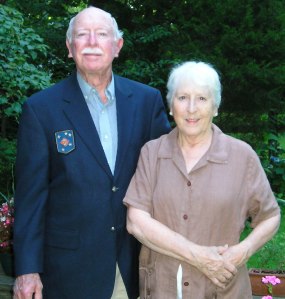
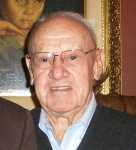
Sergeant Kenneth O'Donnell and his wife Bucky

Sergeant Kenneth O'Donnell, a gentleman and a warrior, with his wife Mary Jane

On the evening of October 8, 2009, Marine Raider, Sergeant Kenneth O’Donnell died as his home after a valiant struggle with brain cancer. Although his name might not mean much to most people, he was a member of a very special group of Marines who fought in World War II. They were the ground breakers for our modern day special forces. It was their job during the first weeks of the war to conduct surprise attacks behind enemy lines. The men who formed this unit were simply known as “The Raiders”.

“They were the first American combat forces to wear camouflage, to operate at night and to be trained in martial arts and knife fighting…Although the Raiders were in business for only two years as specialized units, their actions became the stuff of legend. A look at their decorations for individual acts of valor tells the tale.”[1]

In their brief existence, seven Marine Raiders earned our nations highest award for bravery, the Medal of Honor and another 138 were awarded the Navy Cross.

If the reader will take the time to watch the videos I have provided on the these unique group of Marines, you will see clips of Sergeant O’Donnell. What impressed me most about the man was that, although he was a true warrior, he possessed a refreshing unpretentiousness.

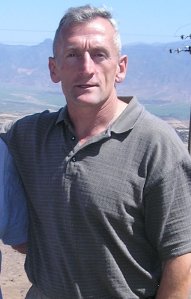
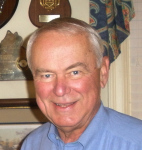
Lieutenant Colonel Joseph C. Shusko, Director of Marine Corps Martial Arts Program (MCMAP)

Lieutenant Colonel Joseph C. Shusko, Director of Marine Corps Martial Arts Program (MCMAP)

Lieutenant Colonel Joseph Shusko, USMC (Ret.), director of the Marine Corps Martial Arts program at Quantico, was with Sergeant O’Donnell before he died and took the took time to speak with me by phone. Shusko said he looked upon the late warrior as a grandfather, then went on to tell me how he would describe the man for those who did not have the pleasure to know him.

“I tell folks that if they look in the American dictionary for the definition of the word gentleman, they will find a picture of Ken O’Donnell.” On this day we should all remember Sergeant Kenneth O’Donnell, a proud member of the Marine Corps Raiders; a gentleman and a warrior.

Sergeant O’Donnell was 85 at the time of his death. Our sincere condolences to his wife Mary Jane.

May he rest in peace.

Marine Raiders Part 1

Marine Raiders Part 2


[1] Marine Raiders Honored at Quantico with Bricks, Museum   http://www.wjla.com/news/stories/0809/651685.html

Tags: , , , , , , , ,

ny lottery

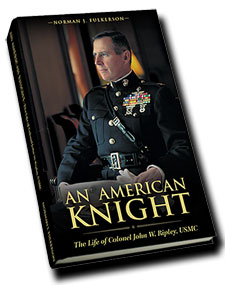
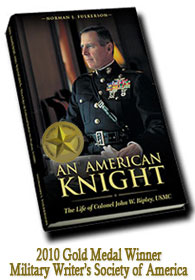
BookIn today’s increasingly troubled society, there is a desperate need for role models, especially among the youth. Colonel John W. Ripley, USMC is an authentic American hero and a true role model, whose life is worthy of admiration and emulation.

Known for his impressive heroics during the Vietnam War, Colonel Ripley earned the Navy Cross, along with numerous other awards. His legendary career in the United States Marine Corps is well-known, but now, for the first time ever, a new book that covers his whole life — from his adventure-filled boyhood in rural Southwestern Virginia to his days at the U.S. Naval Academy, his tours of duty in Vietnam, his post retirement years and finally, the final days before his death — is soon to be released.

* * * * *

In An American Knight: The Life of Colonel John W. Ripley, USMC, TFP author Norman Fulkerson succeeds in telling the fascinating story of this legendary Marine, whose ancestors fought in every American conflict since the Revolutionary War.

In An American Knight, Norman Fulkerson shows:

**Colonel Ripley’s deep Catholic Faith, his love for his children and his devotion to his wife, Moline.

**His many struggles, one of the last being his liver transplant, described by his surgeon as the “most dramatic” one in history.

**The ultimate warrior whose Faith, discipline and morals provided him the strength necessary to vanquish enemies in battle.

**The gallantry of a man who faced public opinion and political correctness when he opposed homosexuals in the military and women in combat.

**How he transformed youthful energy into a determination and ultimately success at the US Naval Academy.

**How he stopped a Communist tank column and 30,000 NVA dead in their tracks.

This makes An American Knight a splendid and inspiring tribute to one of America’s greatest fighting men, whose legacy will deeply mark the souls of all those who love the virtues of the medieval knight: Faith, honor, heroism and integrity.

* * * * *

From the foreward by General James Livingston:

“He [Colonel Ripley] saw accepting risk as part of his job as a Marine. He expressed this while speaking to a group of young men considering a career in the Corps. “Risk comes with the job,” he told them. “If you are not comfortable with risk, you need to get into a new line of work.”
“These and many of Colonel Ripley’s other qualities are enumerated in An American Knight. Thus, I recommend it strongly. I hope my thoughts will help its readers to gain a better appreciation for this Marine who will doubtlessly be remembered as one of the greatest men ever to honor the Corps.”

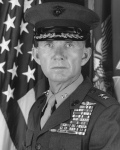
General James Livingston General James Livingston

Medal of Honor Recipient


———————————————————————————————————————————————

Here’s what they’re saying about An American Knight:

“I knew Colonel John W. Ripley like a brother for 42 plus years, but the facts are that I learned still more about my Marine buddy from Norman Fulkerson’s book… Norman goes into family and early life details that started this Marine on his most successful Marine career as well as John’s perception of the obligation and performance of his duties in uniform. This is a “must read” for all desiring to be a leader, especially those desiring to lead Marines.”


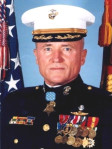
Colonel Wesley L. Fox Colonel Wesley Lee Fox, USMC (Ret.)

Medal of Honor Recipient

Author of Marine Rifleman: Forty-three Years in the Corps and Courage and Fear

——————————————————————————————————————————————–

“In his new book An American Knight, Norman Fulkerson has vividly captured the extraordinary active journey in life of Colonel John Ripley. In this first ever biography of a truly legendary Marine, the reader will see a man of many images; a gentle person who was comfortable with people of all stations of life, a caring father, a faithful husband, and a Marine capable of doing the seemingly impossible when I ordered him to destroy the Dong Ha Bridge.

“Because of his compelling and uncommon level of service to this great nation, Colonel John Ripley truly deserves to be held up as a role model for all to follow. Norman Fulkerson’s book will help to insure this.”

Col Gerald TurleyColonel Gerald Turley, USMC (Ret.)

Author of The Easter Offensive

—————————————————————————————————————————————-

“An American Knight by Norman Fulkerson is an outstanding tribute to one of the finest men to ever wear a uniform of the United States of America.”

Paul Galanti HomeCommander Paul Galanti, USN (Ret.)

POW for seven years


*                     *                   *

To pre-order your copy of An American Knight: The Life of Colonel John W. Ripley, USMC, by Norman Fulkerson, visit www.americanknight.org or call 1-888-317-5571.

Tags: , , , , , , , , , , , , , , , , , , , , , , ,

Written by: Norman Fulkerson

When Michael Monsoor jumped on a grenade to save the lives of three Navy Seals in September of 2006, the nation was left speechless. The Medal of Honor was presented to his grieving parents, during a White House reception, as a mournful audience looked on. There was a man in the room that day that might have seemed like just another soldier, if not for the peculiar spring in his step.

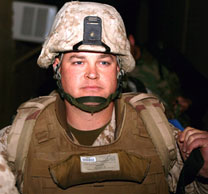
His name is William “Spanky” Gibson. He had just flown in from overseas and had a good reason for being present at the ceremony. He lost his left leg during a firefight in Iraq six months before and it was Michael Monsoor who provided cover in a rooftop overlook that contributed toward saving his life. It would be hard to find someone more worthy of that sacrifice than William Gibson. Like Petty Officer Monsoor, he is a tribute to the American soldier and his story deserves to be told.

Gunnery Seargent William “Spanky” Gibson

Idealistic Youth
William Gibson acquired the nickname “Spanky” in boot camp. Although it had nothing to do with his likeness to the roundfaced kid in “The Little Rascals” series, he does radiate much of the innocent charm of that little boy.

By the time “Spanky” was only five years old, his father, William Sr., said he knew exactly what he wanted to be in life.

“When I grow up,” he said, “I am going to be just like grandpa.”

His grandfather, Peterson Parrott, a 30-year Marine, visited his impressionable grandson on a stopover while transferring from the East to the West coast. When Spanky saw his grandfather in uniform with all his decorations, he was fascinated. During his stay, Mr. Parrott kept his medals on a high shelf out of reach of the idealistic youth but made him a promise.

“When you grow tall enough to reach those medals,” Mr. Parrott said, “You can have them.”

By the time he grew tall enough, he had already joined the Marines and was well on his way to earning his own medals for bravery.

“[A soldier is] all he ever wanted to be,” said his father.

Firefight in Ramadi

After joining the Marine Corps he earned the rank of gunnery seargent. In May of 2006, he was leading a four-man team through the streets of Ramadi, Iraq on a foot patrol. They were searching for the notorious Abu Musab al-Zarqawi in the most dangerous city on earth.

Alongside him was an Iraqi soldier; a man he helped train.

Suddenly they came under fire from a sniper in a nearby house. The Iraqi soldier was shot in the knee and incapacitated. With total disregard for his own safety, Sgt. Gibson ran to his rescue when a 30-caliber round ripped through his left knee cap, destroying the socket and severing his femoral artery.

The identical nature of the injuries, coming from a trained enemy marksman might have been an intentional plan to increase the confusion of already violent firefight. If they thought Sgt. Gibson would just lie their screaming in pain before being finished off later, they were sorely mistaken.

“Gunny” Gibson, as his men often called him, never missed a beat. Thinking that his knee had only given out, he attempted to stand before realizing the severity of his injury. Not allowing this to deter him, he simply rolled over and began returning fire. If not for the immediate assistance given to him by a SEAL corpsman, he would have bled to death on the battlefield. As he was dragged from the scene, he continued to lay down suppressive fire in spite of the pain and massive loss of blood.

“When Can I Return to Iraq?”

Sgt. Gibson was eventually flown back to the United States and waiting for him at the airport was Gen. Michael Hagee, the Commandant of the Marine Corps. Without a trace of self pity, Sgt Gibson asked the Commandant a curious question.

“What will this do to my career?”

The Commandant assured him that it would affect his career only to the degree that he allowed it to do so. This was a veritable invitation for Sgt. Gibson to fight as hard towards full rehabilitation as he fought on the streets of Ramadi. The fight began when he was encouraged to get out of the Marine Corps. Undeterred by the suggestion, William Gibson called the Commandant directly and found the support he needed to remain.

What Sgt. Gibson faced later is truly inspiring. The lower part of his left leg had been amputated overseas before he arrived at Bethesda Naval Hospital in Maryland. In spite of the seriousness of his injury, he mystified those around him with the constant inquiry: “When can I return to Iraq?” Those witnessing such determination were shocked, considering he might lose the rest of his leg. They were wondering how he would adjust to a life with a prosthetic while Sgt. Gibson was thinking about fighting a war with one.

“I would beg the surgeons every time they would come in,” he said with a smile, “to cut it off, close me up and get me out of here.”[1]

He knew that “out of here” meant one step closer to his goal of returning to combat with or without the remaining part of his left leg. The surgeons were unsuccessful. Sgt. Gibson ended up losing the rest of his leg, but he never lost his will to fight.

“It isn’t growing back” he was quoted as saying, “so let’s start recovering.”[2]

As unbelievable as this might be, Sgt. Gibsons attitude towards a long recovery was even more so.

“What is the shortest time of anyone recovering from such an injury?” his wife Chaney remembered him asking the doctors. He was told that the quickest anyone made it through rehab was thirteen months, but some were as long as eighteen to twenty four months.

“I am not doing that,” was Sgt. Gibson defiant response.

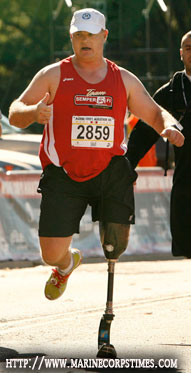
Sgt. Gibson in the Marathon.

Escape from Alcatraz
He then began an astonishing rehabilitation program. Two months after his injury he stopped taking all his medicine including that for pain so as to be clearheaded and focused. Shortly after that, he began taking his first steps on a new prosthetic leg with the help of crutches. Three months later, he participated in the Marine Corps Marathon on a hand bike, then it was on to skiing and later ice climbing.

It wasn’t long before he tackled something which even a man with two legs would hesitate attempting and that was the Escape from Alcatraz Triathlon. This would turn out to be the break he needed to return to Iraq.

The Triathlon is a yearly event in which swimmers are dropped on the island in the San Francisco Bay where the famous prison is located. The first part of the Triathlon entails swimming to shore in freezing cold, shark-infested waters. Sgt. Gibson made the swim with only one leg and came in among the top ten.

When he reached the shore he was greeted by the 1st Marine Expeditionary Force Commanding General James Mattis.

“What can I do for you, Marine?” Gen. Mattis asked the winded but determined soldier.

“I want to be re-deployed,” said Sgt. Gibson.

“You can come with me in January,” Gen. Mattis said, “or a later flight, which would you prefer?”

Sgt. Gibson chose the first flight out and after making the trip in January of 2008 with General James Mattis, he has become the first full leg amputee ever to return to duty in a combat zone.

“I Have Just Done My Job”

Although what he has done is extraordinary, his mother says her son wouldn’t agree.

“He doesn’t feel like he has done anything special,” she says. In the face of a writer who approached the family with the idea of writing a book about Sgt. Gibson, his mother says his attitude remained the same. “Why would anyone want to read about me,” he argues, “I have just done my job?”

Perhaps the most amazing thing about William Gibson is his refusal to allow the loss of a leg to get him down. This no doubt is a character trait he inherited from his father; a Vietnam veteran who suffered a broken back in combat. When doctors told William Sr. that he would never walk again he proved them wrong. “You never say can’t,” Mr. Gibson said. “It might be difficult, but you can do it.”

The only moment of sadness for Sgt. Gibson came with the thought of having to leave the battlefield after his injury.
Chaney Gibson described her husband as someone who leads by example. “He would never put one of his Marines out there alone to get hurt,” she said. “He felt like he had to protect them.”

At the time he was wounded, Sgt. Gibson was a 35-year-old veteran Marine, fighting alongside much younger Marines who were seeing their first action. He believed strongly in leading his men in battle, not pushing them from behind. It was for this reason that he was disappointed at having to leave “his boys” alone in battle while he was evacuated.

He would go on to say that if given the chance to change anything that happened that day, he wouldn’t. “Better me,” he said, “than one of my men.”

* * *

Sgt. William “Spanky” Gibson is safely home now and while his return to battle without a leg might have earned him a place in the history books, his example has earned him a place in the heart of every patriotic American. He represents all the best our country has to offer and it is nice to know that the sniper bullet which cost him a leg, didn’t touch his honor. Bullets, after all, can be purchased but true valor is priceless.

Footnotes:

  1. http://soldiersangelsgermany.blogspot.com/2008/04/mike-monsoor-and-spanky-gibson.html
  2. http://www.foxnews.com/story/0,2933,333534,00.html

mamba

Tags: , , , , , , , , , , ,

Written by Norman Fulkerson
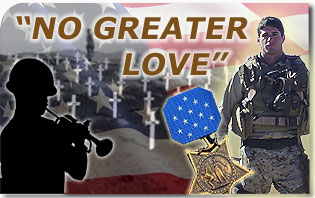
On September 29, 2006, Ramadi, Iraq was considered the most dangerous city on planet earth for American servicemen. Michael Monsoor was there in the midst of it all. He was a member of the elite branch of the Navy called SEALS, which stands for SEa, Air and Land. On that day, he was on a rooftop over-watch in the most contested part of the city called the Ma’laab district. Positioned near the only exit, with an MK 48 machine gun in hand, he was providing security for two SEAL snipers who lay in prone positions on either side of him. Moments later a fragmentation grenade bounced off his chest and landed on the ground…

Becoming a Navy SEAL

Although nothing can adequately prepare one for such a circumstance, Michael Monsoor seemed to be living a life which pointed to it. He was an adventuresome boy growing up in Southern California. His father George and older brother Jim had both been proud Marines. His boyhood dream of being a SEAL began to be realized when, at 20 years of age, he joined the Navy.

In the first phase of training, he broke his heel. Exhibiting the selflessness which would become his trademark, he continued to run with a pain so excruciating he nearly passed out. Unable to continue, he was forced to ring the bell indicating that a trainee had quit the program. He was medically rolled back and sent to Italy for a year where he spent the majority of his off time doing physical training. His mother, Sally, when visiting him, said he hardly ever stopped running.

He then reentered a grueling SEAL program where only 23% pass, graduated at the top in the class of 2005 and was assigned to Delta Platoon. In April 2006 he was sent to Iraq on his first tour of duty.

From here we almost lose our breath as we follow the rapid upward trajectory his life would take.

Rescued from the Jaws of Death
As a heavy-weapons machine gunner, his position while patrolling the streets of Ramadi with Delta Company was right behind the point man. The responsibility for protecting the rest of the unit fell squarely on his shoulders. It was an appropriate position for a Catholic young man named after the warrior angel, Saint Michael.

He was also a SEAL communicator which required him to carry a rucksack full of communications equipment in addition to his MK 48 machine gun full of ammunition. He carried the extra 100 lbs, without complaint, in temperatures as high as 130 degrees.

In May of 2006, during his first month in Iraq, his unit came under fire during counter-terrorist operations. Heavy enemy automatic weapons fire resulted in a wounded SEAL who was left exposed to enemy fire. Michael threw caution to the wind and ran directly into the line of fire to help the injured soldier. As gun fire chewed up the asphalt around him, Michael snatched the wounded soldier from the jaws of death with one arm, returned enemy fire with the other and then dragged him to safety.

He then maintained suppressive fire while the wounded SEAL received tactical casualty treatment. After loading his wounded teammate onto an evacuation vehicle, he returned to the battle. This act of heroism earned him a Silver Star and a reputation for putting others first.

Some months later the injured soldier had a dream of the incident where the Michael who rescued him had wings. He later had an artist make a reproduction of the image in his dream depicting Michael Monsoor in dress blues with a loaded MK 48 Machine gun and silvery wings. As a tribute to Saint Michael the Archangel, who he felt was there with them, he included the short exorcism which invokes the warrior angel to “be our protection against wickedness.”

Streets Paved with Fire
Such protection was sorely needed especially considering that 75% of the missions involving Michael’s platoon came under attack. Thirty five escalated into heated firefights taking place in “streets that were paved with fire.”[1]

During eleven of those missions Michael’s leadership, guidance and decisive action were key in saving the lives of many of his men. For his heroism he was awarded the Bronze Star. The citation accompanying the medal describes how he “exposed himself to heavy enemy fire while shielding his teammates with suppressive fire. He aggressively stabilized each chaotic situation with focused determination and uncanny tactical awareness. Each time [terrorists] assaulted his team with small arms fire or rocket propelled grenades, he quickly assessed the situation, determined the best course of action to counter the enemy assaults, and implemented his plan to gain the best tactical advantage.”[2]

In the midst of such violent action, Michael Monsoor displayed what Secretary of the Navy, Donald Winter described as a “cool headedness under fire” and “when hostility broke out, he proved he was a SEAL you wanted on your team.”[3]

As extraordinary as all of this is, it was merely a prelude to the defining moment of his life in the rooftop over-watch.

“Path of Honor”
When the grenade landed in front of him, Michael Monsoor knew that the length of the fuse would not allow him to toss it out. He also knew that he was two short weeks away from returning home to family and friends. Plans were already made for him to see his younger brother play in a football game for North Dakota’s Minot State University.[4]

With the only exit door at his back, a live grenade at his feet and two Navy Seals in front of him he was faced with the hardest decision of his life. It was one of those rare moments when life passes before your eyes. Having already endured so many hardships and numerous brushes with death no one would have faulted him had he chosen a path to safety.

“He chose a different path,” said Mr. Winter, “a path of honor.” On numerous occasions, Michael Monsoor stared death in the face in his heroic defense of others. Once again he and death would meet and once again he put others first. With unflinching selflessness he gave his life so that others might live. In so doing, he saved the lives of three Navy SEALS and eight Iraqi soldiers.

One of the survivors described how “Mikey” looked death in the face that day and said, “You cannot take my brothers, I will go in their stead.”[5]

“He never took his eye off the grenade, his only movement was down and toward it,” said a 28-year-old lieutenant who lived to tell the story. “He undoubtedly saved mine and the other SEALs’ lives.”[6]

Another eyewitness described Michael’s countenance, as “completely calm, showing no fear only resolve.”

It could easily be said of him what Gen. Pericles said in his funeral oration for the warriors of ancient Athens, “He passed away from the scene, not of his fear, but of his glory.”

Feast of St. Michael the Archangel
Michael Monsoor was immediately evacuated to a battalion aid station. Fr. Paul Anthony Halladay, his platoon chaplain, was with Michael as he passed away approximately 30 minutes later.

It was an appropriate end for a Catholic soldier who, according to many reports, was a practicing Catholic. His fellow soldiers told how he frequently attended mass “with devotion” before his operations.

Patricia Monsoor, his aunt and godmother, said he “went to confession frequently” and “other soldiers who were not practicing would sometimes follow [him to mass] because of his good example.”

When he was posthumously awarded the Medal of Honor, a tearful President Bush reminded the audience that the day Michael Monsoor died was the feast of Saint Michael the Archangel.

An emotional Donald Winter quoted a passage from scripture already remembered by so many to describe Michael Monsoor. “Greater love than this no man hath, that a man lay down his life for his friends.”

“When it came down to laying down his life for his friends, his faith allowed him to [do so] without a moment’s hesitation,” said Father Halladay.[7]

“I Have Given Everything”
The most moving tribute to Petty Officer Michael Monsoor was that given by Lt. Commander John Willink during an evening ceremony at the Navy Memorial honoring the fallen hero.[8]

He described in detail a photo of Michael released shortly after his death. The picture shows Michael walking at the head of his platoon, through the war-torn streets of Ramadi. They are shrouded in a greenish yellow mist used to mask their movements from the enemy. In spite of the chaos and danger which surrounds them, Michael is calm, almost smiling.

“As I look at this picture,” Lt. Willink said, “I hear a voice in a humble but confident tone.”

He then finishes his speech with the words he imagines Michael saying to him. They are words which I feel Michael Monsoor is saying to every American who appreciates the unbelievable sacrifice he made in a faraway land. Far from his family and the country he loved.

“I am Michael Monsoor…

“I am patrolling the streets of Ramadi… My eyes sting from the sweat, my gun and gear are heavy but these things do not bother me. There is no comfort here but this is the life I have chosen and there is no place I would rather be…and I am ready.

“I am Michael Monsoor… I miss my family. I want to hold my nieces and nephews again. I want to make them smile and laugh but I am far from home. Instead I smile at the Iraqi children when we pass them by. When we encounter Iraqi families I treat them with respect and dignity. I know the importance of family because there is nothing more important to me, than my family…

“I am Michael Monsoor, I love my country, my fellow SEALS and the men fighting along side us… I have lived life to its fullest. I have not looked back. I leave nothing but love and I have no regrets.

“I am Michael Monsoor… and I have given everything…For you!”

Footnotes:

  1. http://www.blackfive.net/main/2008/04/us-navy-seal-mi.html
  2. http://www.navy.mil/moh/Monsoor/bronze.pdf
  3. http://www.navy.mil/moh/Monsoor/hoh.html
  4. http://www.landstuhlhospitalcareproject.org/Honorees/Michael%20A.%20Monsoor/Michael%20A.%20Monsoor.htm
  5. http://mksviews.wordpress.com/2008/04/23/you-cannot-take-my-brothers-i-will-go-in-their-stead
  6. http://www.military.com/NewsContent/0,13319,116817,00.html
  7. http://www.freerepublic.com/focus/religion/2006608/posts?page=5
  8. http://www.navy.mil/moh/Monsoor/flag.html

loveplanet

Tags: , , , , , , , , , , , , , , ,

Newer entries »